


Your brand identity is holding you back.
Hi, Thomas Ingersoll here. I'm a commercial and advertising photographer in Phoenix, Arizona. I am taking over Blok's blog this week and want to share something that has changed how I get clients, and how clients perceive me.
This week I want to talk about the importance of being a brand and having a strong identity. Now, this may seem like a no-brainer, but it is commonly overlooked in our industry. In today's climate, it is not enough to be a good photographer. The days of just having a strong portfolio are dead. A photographer must be a brand, an experience if you will. Our market praises brands that create an experience, consistent in their identity, and easily assessable on all platforms. This will garner trust and reliability with your audience; they know what they will get when they come to you. It also conveys that you are willing to put the time in to represent yourself and what you want to share with the world. So where do you start? I will break down the crucial aspects of developing a robust unified identity.
- Start with your work. Align your work with your brand's identity, make sure they compliment each other. If you are a lifestyle photographer, things like your design, font, color, logo, and voice should convey that message. This will help establish your persona before your audience even begins to browse your work.
- Establish what market you are after. Are you pursuing retail, commercial, editorial, etc.? You will want to articulate on your platforms who you are and the type of work you do. I market myself as an advertising and commercial photographer. I make sure on all platforms that I state that. I also make sure my SEO practices relate to those terms.
- Show people who you are. You're a photographer; you should have a beautiful photo of yourself. Keep a consistent biopic across all your platforms.
- Logo. This is usually people's first impression of the type of work you do. Spend some time and make sure your logo represents yourself well.
- Develop a brand color. This will help support your logo and design. People will start to associate your brand with a color, look at companies like H&R Block, McDonald's, Coca-Cola, and Air BnB.
After establishing your brand identity, apply this across your platforms.
Website
First is your website. This is the staple of your identity. This is where you want to drive traffic to. All marketing attempts should funnel people to your site. Your website should be an experience for your audience, and make it a pleasant and memorable one. Your identity should sing through your site, and make it easy to navigate damnit.

Social Media
Use this free form of marketing to establish your voice, identity and accessibility. Have a unified bio pic. Market yourself to a specific audience. Drive people to your website.
Consider what you post, make sure it relates to what you're photography.
Instagram is great for a personality. Share your BTS, technical info, and your portfolio. Don't be afraid to some personal experiences here.

This is a great space to share links and stories. Be involved in communities. Keep personal stuff to a personal account.

Great to find a network of professionals. Share your stories.

Use this platform to share BTS and links. Almost a mix of Instagram and Facebook.

Business cards and mailers
Don't ignore the world that exists outside of the internet. Print is still a very crucial aspect of marketing and identity. I love using leave behinds and business cards for more professional settings. Make sure that the design of your cards, print portfolio, and leave behinds are all an extension of your brand.


Conclusion
Throughout my presence I remain consistent. My branded color is a deep red white. My style is minimal with a slight modern touch. All my platforms look the same so my audience knows its me. I state that I'm an advertising/commercial photographer. Implementing a strong brand into my business structure has helped elevate the type of clients I get.
Take a look and ask yourself if you are a strong brand.
Resources
Website - Squarespace
Business Cards and Mailers - Moo
Also be sure to check out Agency Access. They have tons of insightful info on their blog, as well as a team of professionals that can help develop your brand.

Learn how to be a director with Thomas Ingersoll.
This week our Blok EDU instructor, Thomas Ingersoll, gives some vital information on how to make sure you're an effective director! His post takes you on a step-by-step process from meeting the client(s), to delivering the final images. You can check the entire post HERE!


Mixing Ambient Light With Strobes.

Image by Thomas Ingersoll
Blending ambient light with strobes can be deceivingly tricky. In this post, commercial photographer, Thomas Ingersoll shares some helpful tips.
Find Your Ambient Light First
The first thing you should do is evaluate your scene. Study where your ambient light is coming from. This is crucial to understanding where to add your strobes. I will try to utilize the ambient light as much as I can, I want the ambient light to do most the work for my scene. I will meter for the ambient light then slightly underexpose the subject. This makes sure the ambient light is providing my scene with the proper fill light that is needed, and once I add the strobes they will give me the sharpness and control that I desire. Also, make sure there is enough ambient light. I usually won’t mix the two if I have to shoot above ISO800.
Add One Light At A Time
Whenever using strobes, you want to add one light at a time. Your overall look will determine the number of strobes you need, but always add one at a time and make sure each strobe has a function. First was the ambient light. Now you will start to add strobes into the scene. When mixing ambient light with strobes I will use 1 or 2 strobes; I don’t find myself needing more than two strobes.
Match Light Direction
Matching the light direction is essential. I will assess where the ambient light is coming from and use my strobes to compliment it. So if I have a big window on the left, I will put my key light on the left as well. Then if I need a fill light (to fill in the shadows) it will be on the right or behind me. This will make your scene much more believable and natural.
Use Strobes Subtly
When combining strobes and ambient light you want to ask yourself how will strobes benefit the scene. My goal is to make the scene look almost as if it was just natural light. I try to use strobes almost as a fill light. Use the strobes at a very low power. I see a lot of photographers go wrong here. They will crank up the power on the strobes and lose most of the ambient light. It’s also important to have strobes that will go low enough in power for these types of shoots. This is why I love the Profoto B1X’s and D2’s. They go low enough in power to seamlessly blend the two worlds.

Light Color
It’s important to match the color of your ambient light with the strobes. I will use gels to match my strobes color temperature to the ambients color temperature.
Use Soft Modifiers
Using softer modifiers will also make the image look less strobed. Remember bigger modifiers means softer light. Softer light blends much easier than harsh light. I often use two lights to make sure the strobes are soft and transition nicely between each other and the ambient light. My favorite modifier right now for soft light is a Profoto large deep white umbrella with the diffusion. This thing is creamy soft and has the most beautiful light fall off I’ve seen in a modifier. For a fill, I will use a large white V-flat or a 6x6’ scrim. Bouncing light off walls or surfaces is another great way to subtly add more light into your scene.
Harmonize the Lights
The strobes and ambient light should compliment each other. You have to find that balance and let each side do its job. The light direction, color, and softness all need to match between the ambient and the strobes.


Importance of Strobe Lighting
Yesterday we announced the launch of blok EDU and made our first course available for sign up. Within a few hours all the available seats were filled and we couldn't have been anymore excited about the reaction! As mentioned before our goal for this program is to empower, build knowledge and inspire. In this post, we feature some insight from lighting class instructor, Thomas Ingersoll, about the importance of strobe lighting. Enjoy!
Three reasons why learning about strobes is vital
1. Lighting shapes photography, it's the very essence of a photograph.
Light controls every aspect of photography; shape, contrast, color, exposure, mood, etc. Learning how to control light will fundamentally change the way you shoot. Although there is an art in capturing available light, there is an even greater reward in being able to control any environment you find yourself shooting in. Using strobes is another tool on the knowledge belt, just as conquering available light is a tool, and to be a well rounded photographer you should have and master both tools. I don’t approach every shoot wanting or needing to use strobes, but more often than not I find myself wanting to control the light using strobes.
This stairwell was very poorly lit and the florescent lights looked terrible on the model’s face. To overcome this I used 2 strobes. One B800 with an orange gel pointed at the ceiling to give a nice even fill light for the whole image, and one B800 with a beauty dish and a grid as a key light to isolate the model.

2. You are only as strong as your weakest link, don’t let that be lighting.
Even if you are an avid natural light shooter, gaining some basic knowledge about strobes can be extremely advantageous. Sometimes a subtle fill or rim light can make or break an image. Using strobes does not mean that you have to use them all the time or change your style of shooting, it simply means you can have more control over the outcome of your image. There are times when strobes can be the focus of your image or help you balance light in a poorly lit condition. Mastering strobes can help you overcome any situation and deliver the best to your clients.
Using strobes in a studio doesn’t have to be boring. Learn how to use different modifiers to control and shape your light.


3. Show your clients that you can overcome anything.
Whether you shoot weddings, fashion, commercial, sports, etc., learning how to use strobes can show your clients that you can always deliver, no matter the environment. Take your photography to the next level by learning all that you can about light. Learn and master how to use natural light, strobes, a scrim/reflectors, and to bounce light and nothing will stand in your way. Start learning now, even if it’s buying and learning how to use a cheap speedlite. Grow outside your comfort zone and have no limitations.
Adding strobes can create depth to on location shots. Learn how to blend ambient light with strobes and you can create more dramatic images.


I am constantly broadening my horizons with lighting knowledge. I seek out different lighting methods and unique ways to utilize light constantly. Peppered throughout my portfolio are shots using strobes, natural light, and reflectors. Control the light, don't let the light control you.

blok EDU Launch
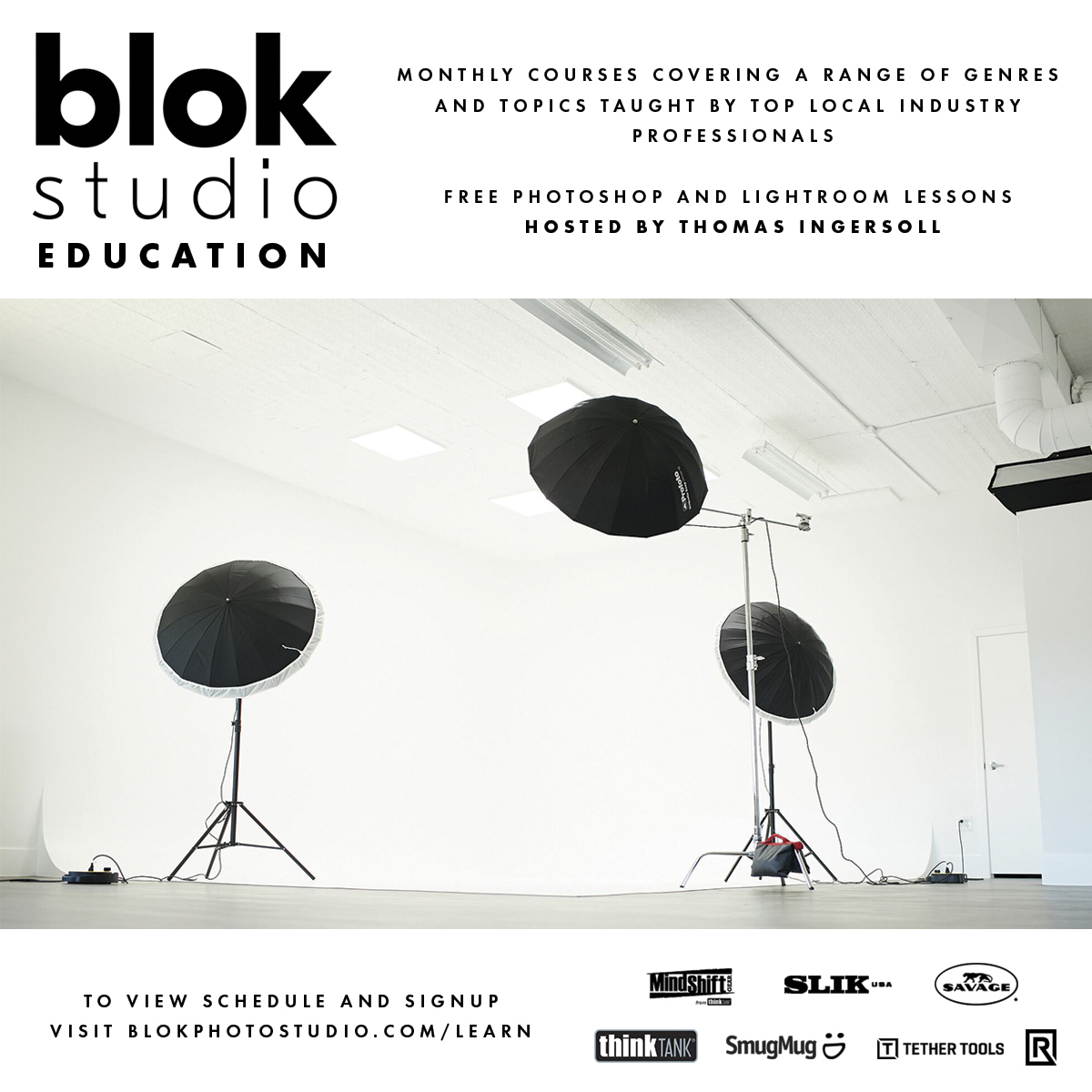
Well folks, the moment is here. We've officially launched our education program!
We curated this program with the intent to bring a unique learning experience to the community. Courses will cover a range of genres and topics within the creative realm. Free Photoshop and Lightroom lessons will be offered as well as seminars designed to inspire. As if that isn't enough awesomeness, we have some incredible giveaways from great sponsors. A calendar of these courses will be found here. Sign up for our mailing list or follow us on instagram and facebook to stay updated on new courses as we will be adding them frequently.
Tomorrow we'll be featuring a guest post from one of our instructors, Thomas Ingersoll, that ties into our first class. He will also be leading the monthly Photoshop and Lightroom lessons. Thomas has a deep passion for photography and teaching. He's done some phenomenal work around the state. You can check out his work here.